From High-Desert Trout to Large-Scale Science: Welcome Dr. Zhongqi Chen to Science on the Fly
Dr. Zhongqi Chen has dedicated his career to understanding how fish handle environmental stress. Now, as a Research Scientist at Woodwell Climate Research Center, he is bringing his expertise in fish physiology, stream ecology and data sciences to the Science on the Fly project as the new Science Lead. We sat down with Zhongqi to discuss why a two-degree water temperature shift is a game-changer for wild trout, how local water sampling scales up to global conservation, and why the single bottle of water collected by our community scientist is a critical piece of a much bigger puzzle.
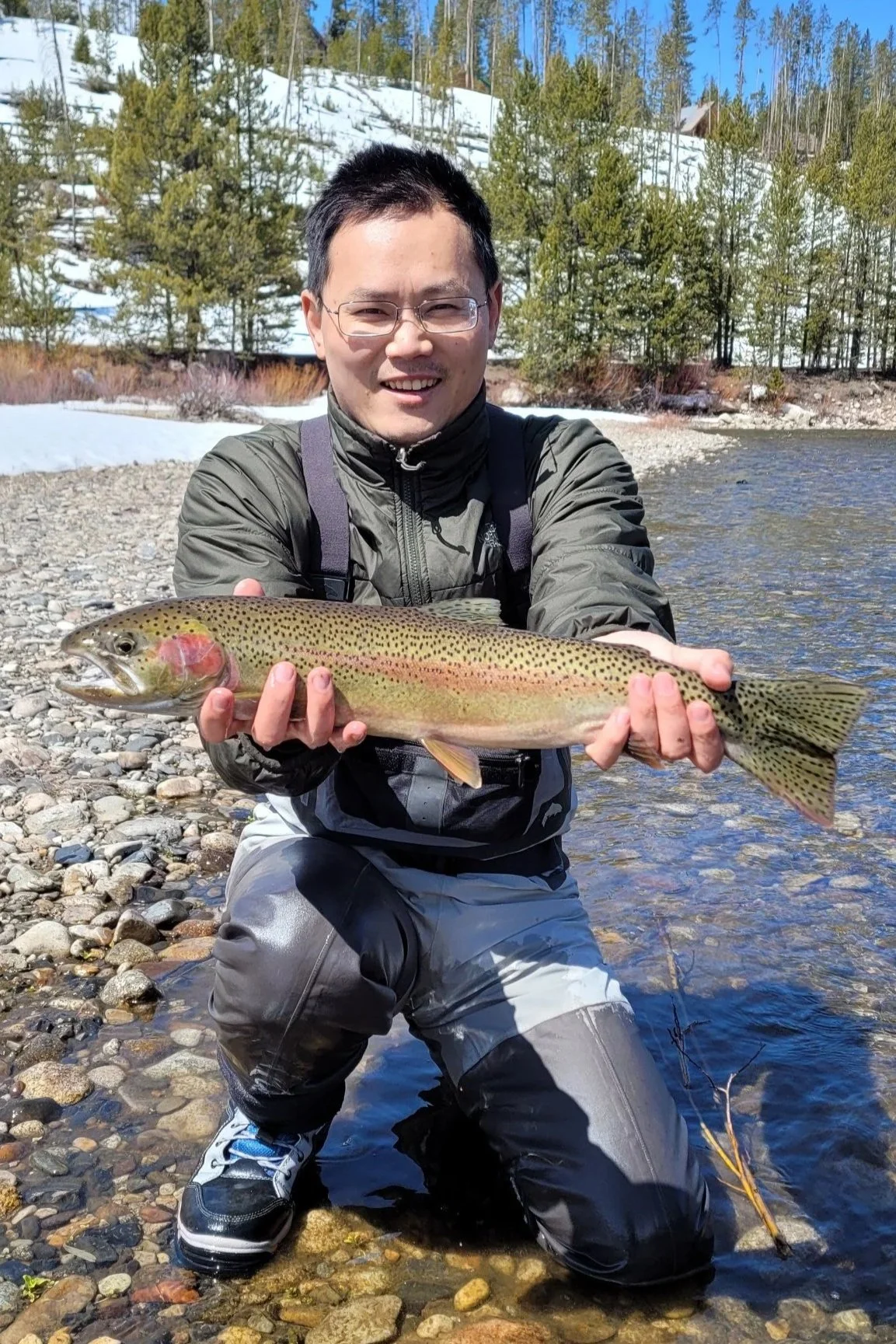
Dr. Zhongqi Chen fishing for steelhead near Stanley, Idaho.
Your research has taken you from the headwaters of the Columbia River to the experimental labs of British Columbia. What was that first 'spark' that made you want to dedicate your life to studying rivers and fish?
The spark must come from aquaculture and growing up around fish. I grew up in Liyang, a water-rich region of Jiangsu Province near the lower Yangtze River region in China. The landscape is flat and filled with lakes, waterways, and aquaculture ponds. The primary aquaculture species cultivated around my hometown and in this region are Chinese perch, various carp species, Chinese mitten crabs, and river prawns. Summer air temperatures frequently exceed 100°F, making heat stress a major challenge for aquaculture.
As a kid, I spent a lot of time fishing and watching how people managed fish in these aquaculture ponds. One thing I noticed was that fish kills happen almost every summer when the water gets too warm. At first, my interest was very practical: I wanted to understand why some fish handle heat better than others, and whether we could select more heat-tolerant strains for aquaculture. That led me to study fish physiology at University of British Columbia. I first worked on iconic Fraser River sockeye salmon, and before long, my interest shifted from aquaculture to wild fish populations. I’m especially interested in how fish from different rivers respond differently to environmental stressors, and how that knowledge can help us protect fish and rivers under climate change.
Can you speak about your favorite fishery, or perhaps your favorite fish that you’ve researched?
One of my favorite fish is Columbia River Basin redband trout. I have spent many years working with and fishing for them, both in the lab and in the field. They are the inland form of rainbow trout. They have been heavily affected by human activities. Major dams have blocked many populations from reaching the ocean, while smaller dams have reduced habitat connectivity. Introduced rainbow trout have also caused hybridization in some places. But redband trout are also incredibly tough. Some live in high-desert rivers in places like Oregon, Idaho, and Nevada, where summer water temperatures can get very warm, close to the upper limits for salmonids. That makes them really interesting from a thermal tolerance perspective, which is what I am most interested in.
They are also probably my favorite fly-fishing target. Part of that comes from fieldwork: my project took me into very remote desert river systems where most people would never expect to find trout. You look at the landscape on a 100°F day and think, “There can’t possibly be fish here,” and then you find these beautiful native trout surviving in those harsh environments. That combination of physiology, conservation, and personal connection makes redband trout special to me.
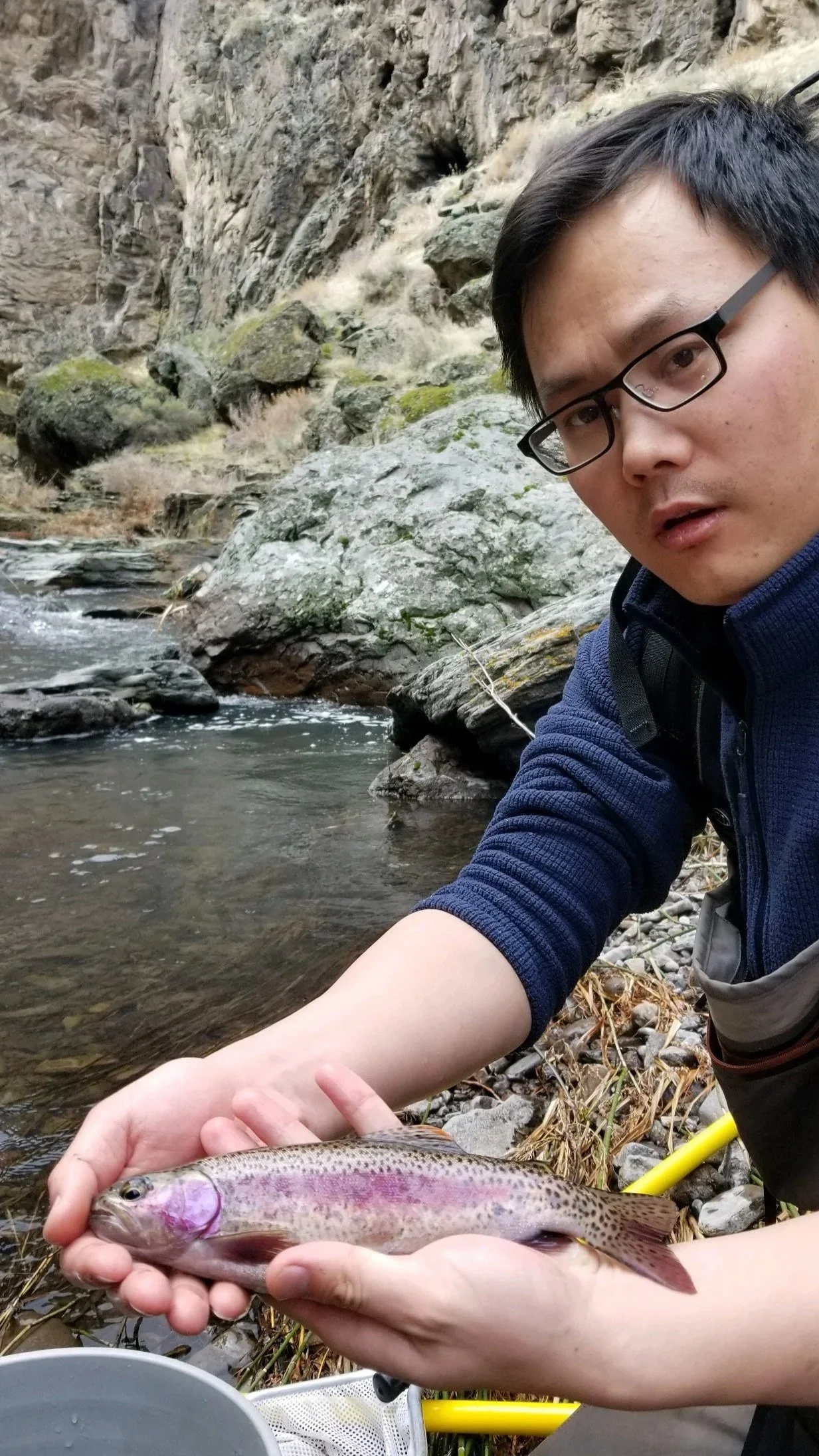
A spawning redband trout displaying its distinctive red stripe in a southern Idaho desert stream during spring. Dr. Zhongqi Chen sampled these fish for a research project to understand how they survive high summer stream temperatures.
Much of your work focuses on 'thermal adaptation.' In plain English, why is a 2-degree shift in water temperature more than just a minor change for a wild trout population?
Fish do not regulate body temperature as we do, their body temperature is basically controlled by the water around them. So when the water gets warmer, everything inside the fish speeds up, heart rate, metabolism, development, and energy demand.
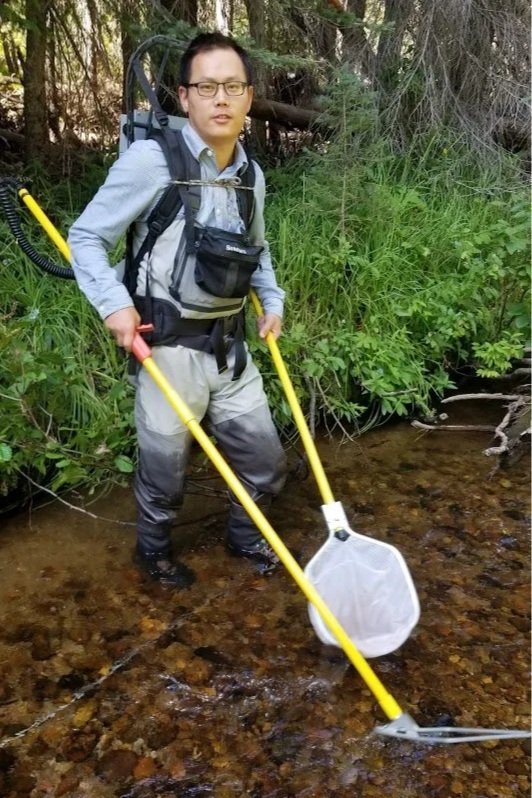
Electrofishing for redband trout in a beautiful mountain stream near Cascade, Idaho. Unlike redband trout in desert streams, these fish live in water that remains clean and cold throughout the year.
That means a trout may need more energy just to maintain basic body functions, leaving less energy for growth, reproduction, or surviving stressful conditions. In spring, a 2-degree change can affect the timing and survival of egg development and hatching. In summer, especially during heat waves, that same 2 degrees can push fish much closer to their thermal limits.
Redband trout are a good example. Some populations already live in very warm desert streams, close to the upper temperature limits for salmonids. For those fish, 2 degrees is not just “a little warmer”, it could mean the difference between a stressful but survivable habitat and one that is no longer suitable. So for wild trout populations, a small temperature shift can change survival, growth, reproduction, and ultimately whether that population can persist in a river.
Based on your research into salmonids, what is the biggest challenge facing cold-water fisheries over the next decade, and how can SOTF help address it?
For me, the biggest challenge is identifying and protecting cold-water fish populations that are most at risk from environmental changes, especially warming, drought, habitat degradation, and pollution.
Climate change is not only causing a gradual warming trend; it is also increasing the likelihood of unusual heat waves, droughts, and other extreme, stressful conditions. So the question becomes: which populations are most vulnerable, and which still have the capacity to deal with the change or recover? This is challenging to answer because there are so many populations. A lot of my research has focused on that question from the fish side. I have worked on asking whether a population has enough diversity and adaptive potential to respond to environmental change. I have also worked on improving monitoring tools so we can better track population status over time.
Where SOTF can really help is on the habitat side. By collecting environmental data at such scale, SOTF can help identify where water quality is changing, where nutrients or pollution may be adding stress, and where cold-water habitats are still functioning well. When we combine fish population monitoring and environmental data, we get a much clearer picture of which rivers and populations need attention first. I believe SOTF can play a really important role by turning local observations and citizen-science samples into large-scale monitoring network.
SOTF relies on a global network of community scientists. How does having 150+ people collecting samples change the kind of questions you can answer compared to a traditional academic study?
Climate change is happening at a global scale, so understanding and responding to it requires a collective approach.
A traditional academic study is often designed around a very specific question and a smaller number of sites. For example, in my thermal adaptation work, we might compare a trout population from a warm river with one from a cold river, and then ask: what physiological or genetic differences explain their different heat tolerance? In my fish monitoring work, we focused on three rivers in Massachusetts to show that underwater video and machine learning can be useful tools. Those kinds of studies are powerful because they are very focused. They cannot easily tell us what is happening across hundreds of rivers at the same time. To reach that scale, they need to be adopted and used by many others.
That is where SOTF is different. With community scientists collecting samples, we can start from a much broader view. Instead of asking only what is happening in one or two study systems, we can begin to build a baseline for freshwater habitat conditions across many regions. Over time, that can be incredibly valuable. So to me, the real power of SOTF is scale. Community scientists allow us to collect data at a level that would be very difficult for a small academic team to do alone.
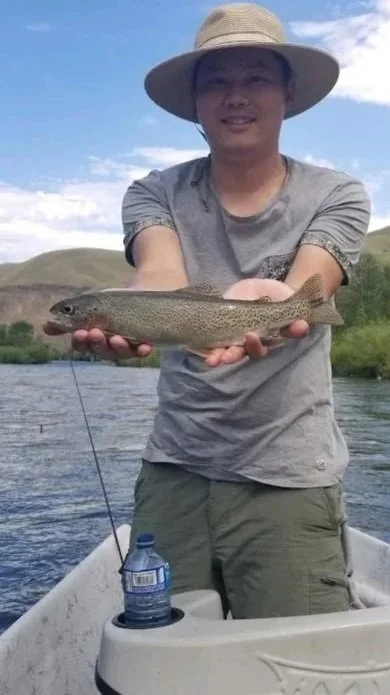
Rainbow trout fishing on the South Fork Boise River, not the biggest catch, but a memorable drift trip with friends.
You’ve been a Research Scientist at Woodwell Climate for a while now. What was the project you just wrapped up? And what makes the Science on the Fly program a unique next chapter for your work at the Center?
The project I just wrapped up used AI-powered approach to monitor river herring spawning migration. Traditionally, river herring monitoring has relied heavily on community scientists standing by streams and counting fish as they pass. That work is extremely valuable, but it also has limits. People cannot be there all the time, and nighttime monitoring is especially difficult, even though fish do move at night.
In this project, we used underwater cameras to collect continuous video, day and night, and then used computer vision to “watch” the video for us, the same way a person would. The goal was to detect fish, track movement and count. To me, it was a good example of how technology can support community science rather than replace it. Instead of asking volunteers to do the same difficult counting work over and over, we can use technology for some of that repetitive monitoring and free people up to ask broader ecological questions.
That is what makes SOTF feel like a great next chapter. In the river herring project, we were focused mostly on the fish: how many are migrating, when they move, and how populations are changing. With SOTF, we are shifting more toward the habitat monitoring, water quality, watershed condition that fish depend on.
So for me, SOTF is exciting because it builds on the same idea of using community science and good data systems to understand rivers at a larger scale, but it expands the question from “how many fish are moving?” to “what is happening to the rivers that support them?”
If you could tell a fly-fishing guide in Montana or a hobbyist in the Appalachians one thing about the importance of the water sample they just collected, what would it be?
I would tell them that every river matters. It may be a small stream in Montana or a creek in the Appalachians, but it is part of a larger ecosystem. The insects, fish, plants, and microbes living there are all part of that river’s story and part of broader freshwater biodiversity. That bottle of water they collected is more than just water. It is a snapshot of the river’s condition at that moment. One sample by itself is useful, but the real power comes when we collect hundreds or thousands of samples across many rivers and over time. Then we can start to see patterns: which rivers are changing, which watersheds are under stress, and which places are still healthy and need protection.
So I would say: a single sample is one piece of a much bigger picture. It is the first step toward understanding the river, and we cannot protect what we do not understand.
Click the links below to discover some of Dr. Chen’s research.
Dr. Zhongqi Chen Google Scholar
MIT Sea Grant- Augmenting citizen science with computer vision for fish monitoring
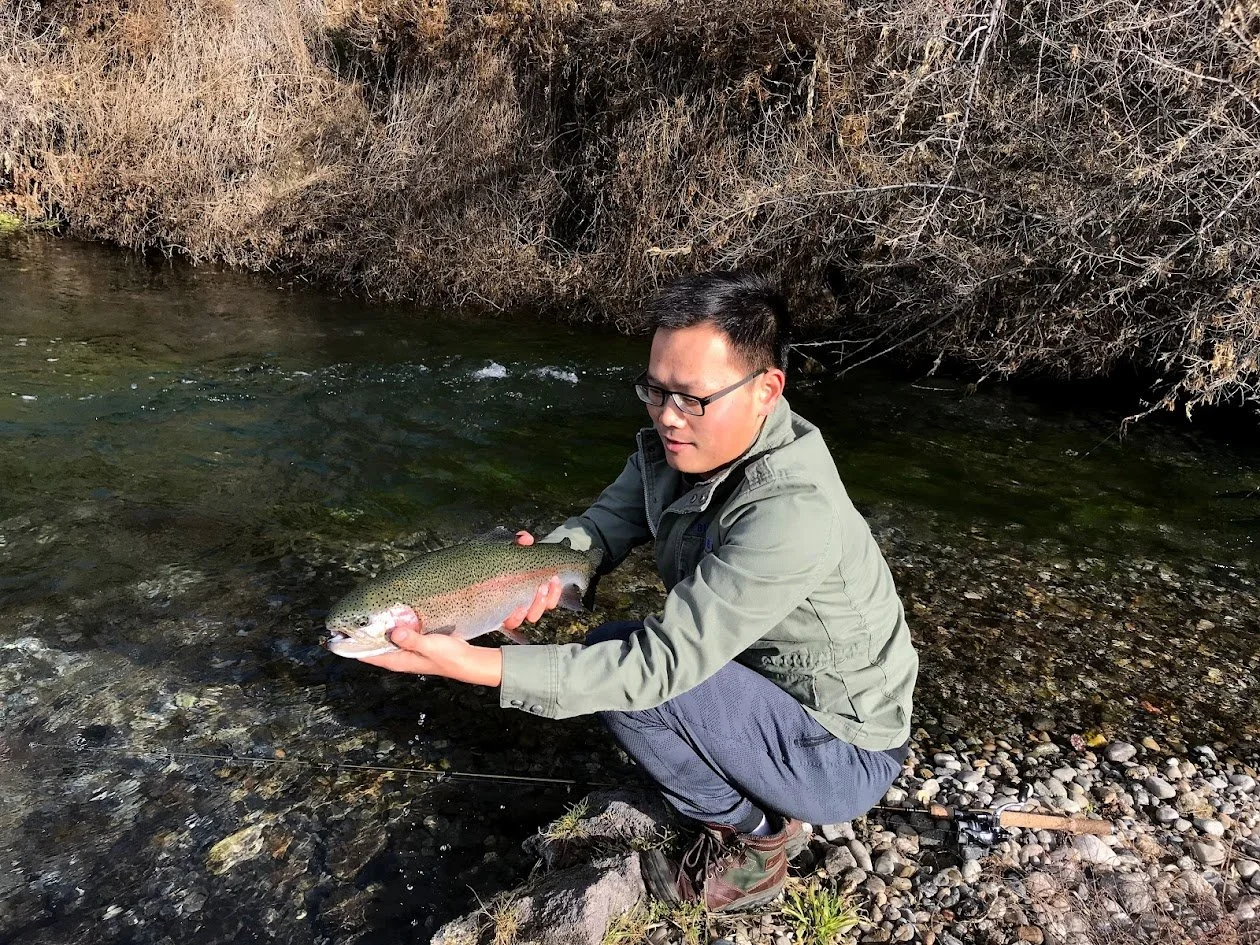
Fishing for Snake River rainbow trout in southern Idaho.